

France international Kylian Mbappe has apologised after a video apparently showed him describing Mao Zedong as a “Chinese dictator,” a remark that cost the Real Madrid forward sponsorship deals with three Chinese companies and led the country’s state television to drop La Liga matches. The replies from the companies, the broadcaster and China’s foreign ministry showed how fast a football controversy can acquire commercial and political significance.
- Key Point: Dongpeng, a beverage maker, Mengniu, a dairy producer, and Milkground, a cheesemaker, each announced that it was ending its partnership with the France international. The three firms used almost identical language and said they rejected conduct that damages national sentiment.
- Key Point: China Media Group, which supervises CCTV, stopped showing La Liga fixtures and withdrew advertisements in which Mbappe appeared.
- Key Point: La Liga apologised and said the player had spoken for himself, not for the Spanish competition. CCTV later said it would take the apology into account while also judging Mbappe on what he does next.
- Key Point: Guo Jiakun, a spokesperson for China’s Ministry of Foreign Affairs, said remarks that offend Chinese people would naturally encounter broad opposition from many quarters of Chinese society.
The clip, the meme and the apology
The row began with footage in which Mbappe discussed his favourite internet meme built around his own image. The clip appears to have been recorded before he appeared on The Bridge, a French online talk programme. In it, he described a picture that placed his face on the body of a man he called:
“some guy … I think he’s a Chinese dictator.”
The person shown seemed to be Mao, who established the People’s Republic in 1949 and governed until 1976. Mocking the former leader, or calling him a dictator, is still forbidden in China. Memes have regularly cast Mbappe as an authoritarian leader, teasing what fans see as his hold over teammates and the idea that he can shape club choices. The European press has nicknamed him “the dictator.”
Mbappe responded with a contrite statement. He said the remark had been poorly judged and that he realised it had wounded audiences in China and Chinese communities globally. He apologised to those upset, said offence had never been his aim, and added that he respected the Chinese people and their past.
“My comment was ill-judged, and I now understand that it hurt many people in China and in Chinese communities around the world. I apologize to everyone my words have upset. This was absolutely not my intention. I have deep respect for the Chinese people and their history, and I am sincerely sorry.”
Sponsors withdraw and coverage is suspended
The commercial response was immediate. Dongpeng, Mengniu and Milkground each said it was terminating its partnership with Mbappe. In statements with matching wording, the companies said they opposed
“any words and actions that hurt national sentiment.”
China Media Group, the body above CCTV, halted La Liga broadcasts and removed commercials featuring the player. La Liga apologised, saying the forward had spoken as an individual rather than for the Spanish competition. CCTV then said it would consider his apology but would also form a judgment from his future conduct.
Asked about the affair, foreign ministry spokesperson Guo Jiakun said:
“words and actions that hurt the feelings of the Chinese people will naturally be met with joint opposition from all sectors of Chinese society.”
The sequence made clear how quickly a remark made for a French online audience can travel into Chinese boardrooms and broadcast schedules. The sponsors moved publicly and in near unison, while the broadcaster’s decision affected the visibility of an entire league. La Liga’s attempt to separate the player’s private comment from the competition did not close the matter, because CCTV linked its next step to Mbappe’s conduct rather than his statement alone. The foreign ministry’s intervention gave the dispute a formal political dimension.
Why Mao remains a sensitive subject
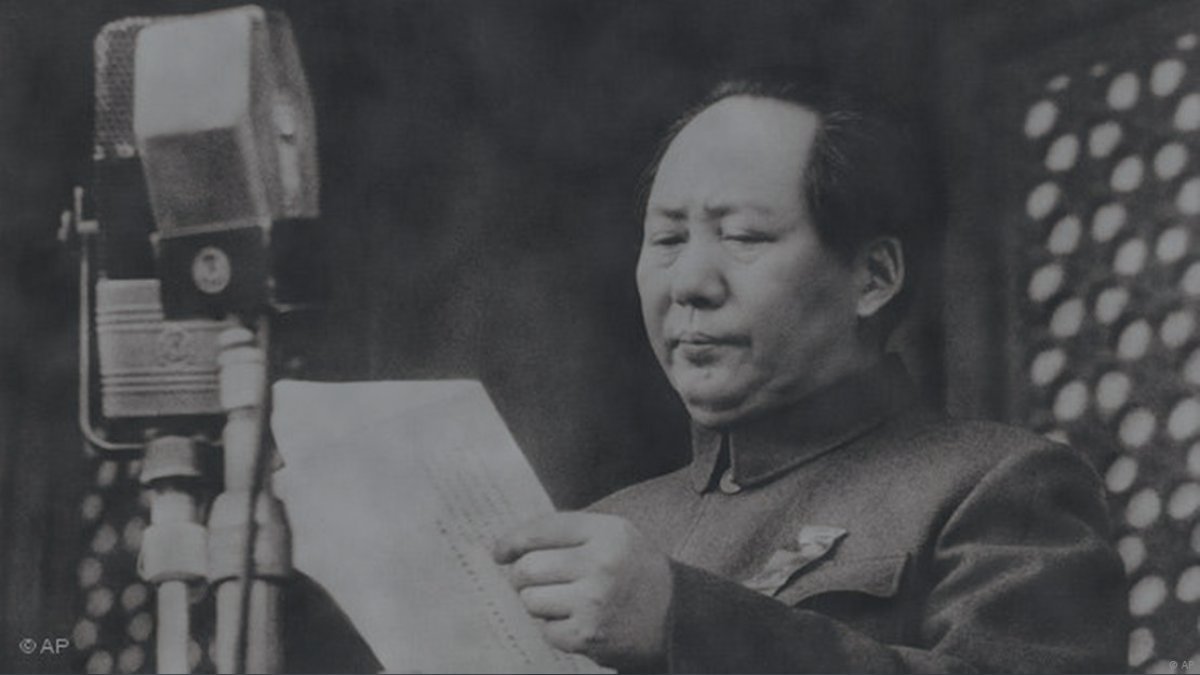
Mao is still widely revered in China, and open criticism of the Communist Party’s founding leader is politically delicate. His rule brought ruinous campaigns, notably the Great Leap Forward; that policy helped cause a famine in which tens of millions died. The ruling party acknowledges that he made mistakes but maintains that his achievements were greater, which is why attacks on his legacy remain so charged. A file photograph accompanying the report was dated October 1, 1949.
That combination of reverence and official caution explains why a passing remark in a foreign clip can carry such weight. The taboo touches how the party presents its own history and the limits that companies and media are expected to observe. For a global athlete, a joke made for a French online audience can be read in China as a statement about a national founder.
The episode shows how a casual comment in a French entertainment setting can reach Chinese sponsors and television schedules within days. Mbappe’s apology may help, but CCTV has tied its next move to his future behaviour, not only his words, so the timing of La Liga’s return and his reappearance on Chinese screens remains uncertain. For a footballer whose commercial reach in China has been disrupted, the cost is now measured in lost partnerships and suspended coverage. The controversy also underlines that Mao’s reputation in China is not merely a matter for historical debate but a boundary that brands and broadcasters are expected to respect. His statement may have eased tensions, but it did not fix a date for La Liga’s return to Chinese television. Alex Berry edited the report.