

Washington has quietly begun re-engaging with Myanmar’s military-backed administration, according to the source account, through two rounds of discussions since September involving Michael Vance, a State Department representative. American diplomats reportedly met Myanmar officials in Naypyitaw and later in Tokyo earlier this month. The US agenda includes confronting online scam centers, obtaining the release of Adam Castillo, an imprisoned American businessman, and possibly securing access to Myanmar’s rare-earth deposits, a market now dominated by China, Washington’s rival.
- Talks in two rounds: Vance has led State Department contacts that started in September; reported venues were Naypyitaw and Tokyo this month.
- US goals: crack down on cyber scams, free Adam Castillo, open access to China-dominated rare earths.
- EU position: Brussels still refuses to recognize the junta as legitimate and has kept sanctions on 105 people and 22 entities, renewed in April for another year.
- Regional shift: Southeast Asian governments are revisiting isolation, several have restored direct diplomatic ties, and Thailand has welcomed the US move.
What Washington is seeking
The US contacts mark a quiet departure from the freeze that followed Myanmar’s February 2021 coup. Washington’s list is narrow and practical: scam centers that have become a regional problem, the case of Adam Castillo, and minerals that matter to global supply chains. China currently controls the market for those rare earths, according to the source.
The opening comes as Southeast Asian capitals increasingly question a policy of shutting out Myanmar’s generals. Several states have already restored direct diplomatic ties, the source says. The EU, by contrast, still refuses to recognize the junta as legitimate in the war-torn country. It was also unmoved by the 2025/2026 election, whose result made Min Aung Hlaing, the military chief, president; the army kept its grip on politics. Human Rights Watch’s Elaine Pearson commented in a DW video on that election.
Brussels keeps its sanctions and aid
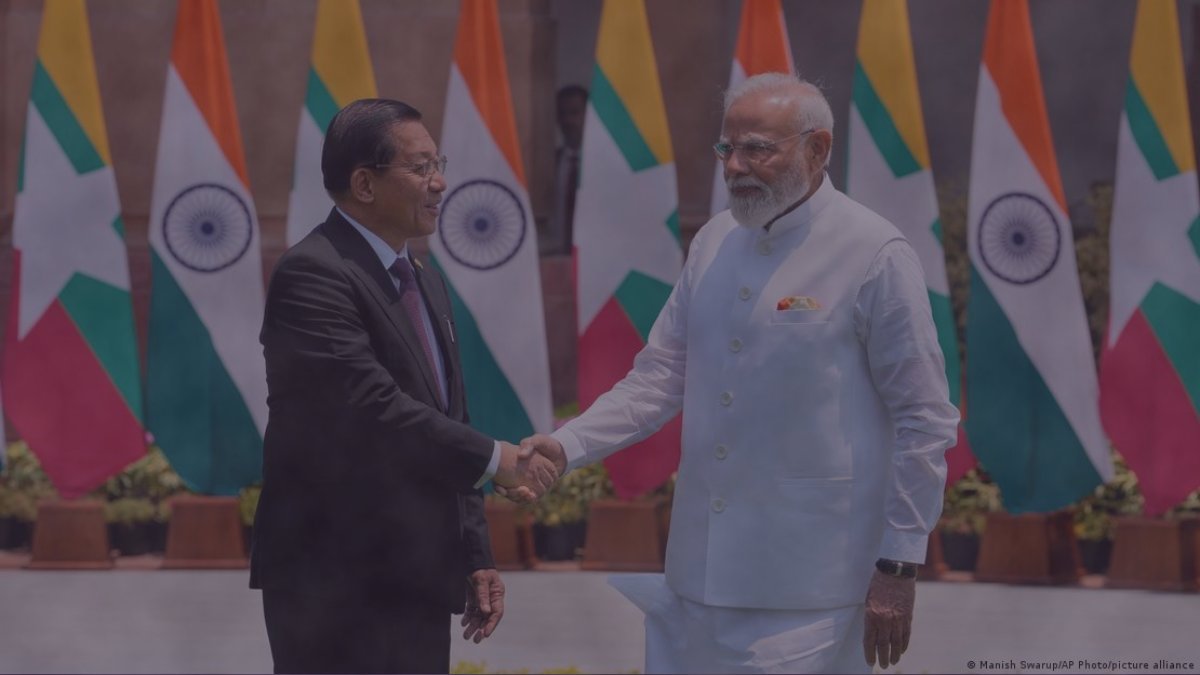
After the February 2021 coup, Brussels halted direct financial help to the government, imposed targeted sanctions and dramatically scaled back its diplomatic contacts with the army. The blacklist names 105 people and 22 organizations linked to the armed forces, and in April it renewed them for a further year. Even with the Western boycott, Hlaing has traveled officially to India, China and Russia; a file image was dated June 1, 2026.
Brussels still funds humanitarian assistance for displaced communities and Rohingya refugees and supports civil society organizations. It has not withdrawn Myanmar’s preferential trade access, citing concerns about workers, particularly the mostly young women in the garment industry. Two-way merchandise trade reached roughly €4 billion ($4.46 billion) in the past year, compared with €3.4 billion in 2019. The EU also backs ASEAN’s peace deal.
“The EU continues to uphold its policy of non-recognition of the current military regime,” a spokesman told DW, citing “the ongoing violence and the attack against its own population.”
“is closely monitoring developments in the discussions and positions of the United States, Japan, ASEAN countries and other major actors with representatives of Myanmar’s military regime.”
The Five-Point Consensus dates from 2021 and remains unfinished.
“It also supports ASEAN efforts, in particular the Five-Point Consensus, which has yet to be fully implemented.”
The 2021 coup set off a civil war that has left about 100,000 dead, the source says. Insurgent groups still hold or fight over wide areas of Myanmar, and more than 4 million people are internally displaced, according to UN data.
Neighbors open doors as the junta courts Europe
After the coup, ASEAN barred the generals from top-level meetings after they failed to carry out its peace plan—an unprecedented step. That is changing: Thailand, Myanmar’s neighbor, is among members voicing impatience. Thai Foreign Minister Sihasak Phuangketkeow last week welcomed the renewed US role and said ASEAN leaders could hold substantive talks on Myanmar at next month’s Manila summit.
Myanmar’s authorities are also trying to break their isolation. In September, Hlaing gave Time magazine his first interview with a major Western outlet since the coup, apparently seeking to rebuild Western ties. On October 22, Burma Campaign UK accused London of a … after the Foreign Office hosted Win Zeyar Tun, charge d’affaires at the junta-run London embassy, during an ASEAN diplomatic event a few days before.
“significant shift in approach.”
Intelligence Online reported this month that Khin Thidar Ay, the junta’s envoy in Brussels, had approached European politicians, including Czech MEP Ondrej Dostal of the European Parliament’s Southeast Asia delegation.
Kristina Kironska, who studies EU policy toward Myanmar at Palacky University in Olomouc, Czech Republic, told DW she saw little reason for Brussels to copy Washington’s opening to the junta. The US strategy, she said,
“appears to be pursuing specific interests.”
She cited rare earth mining and cybercrime. She added that the biggest rare-earth mines have passed from army hands to rebel groups, including the Kachin Independence Organization, which operates in Kachin State.
“It remains to be seen what the US can achieve through negotiations with the junta.”
Brussels has for years cast itself as a champion of Myanmar’s democrats and of human rights. For now, it shows no sign of abandoning non-recognition or its sanctions, even as Washington, ASEAN members and the junta’s own diplomats test the edges of the isolation policy. The pressure is likely to grow as more governments reopen channels to the generals, shifting the debate from whether to talk to Myanmar’s rulers to what Europe should demand in return.