

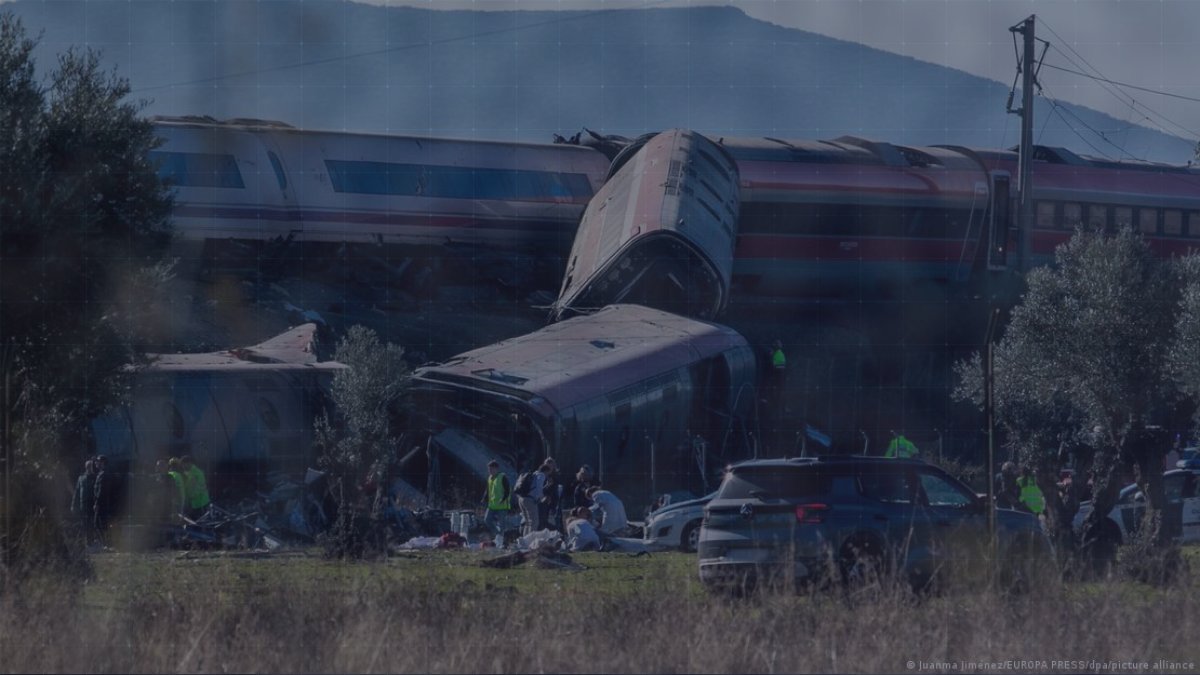
A collision involving two high-speed trains on the Madrid-Andalusia line near Urda, in Toledo province, killed no fewer than ten people and injured others on Wednesday morning, according to the Castilla-La Mancha regional government. The crash happened shortly after nine local time. A spokeswoman for the regional administration said the first count was ten dead and warned that the early reports were grim. Emergency crews rushed to the scene, and images showed at least two badly damaged carriages on their sides after falling down an embankment.
- Key Point: Regional officials confirmed an initial toll of ten dead and said more casualties were possible; Spain’s health minister called the incident a “high impact accident” that could become “a major tragedy.”
- Key Point: An AVE service was reportedly carrying 397 people and an IRYO train 146, according to the Castilla-La Mancha spokeswoman, while Adif suspended traffic on the Madrid-Andalusia high-speed route after a rear-end collision.
- Key Point: The response drew on three helicopters, two mobile intensive-care units and multiple fire crews; the health minister stressed the need for nearby hospitals with ICU beds.
- Key Point: The crash occurred months after a January derailment and collision near Adamuz in Andalusia that killed 46 people and injured more than 150, the worst Spanish rail disaster since 2013, when 80 died.
What is known about the crash
The accident took place near Urda, a town in Toledo province, just after 9 a.m. on Wednesday. Manuel Galans, the town’s mayor, said emergency services were dealing with a collision and injured passengers.
“There has been a collision between two trains [and] there are injured people,” he told local media.
Jesus Perez, mayor of the nearby village of Los Yebenes, told Spanish television that the incident looked “serious.” Local media carried the first accounts from the regional government and the two mayors as emergency teams arrived.
No cause had been established in the immediate aftermath. Early reports indicated that one train struck the rear of another that was already stopped on the line. Adif, the rail operator, said on social media that the Madrid-Andalusia high-speed corridor had been shut.
“Traffic on the Madrid-Andalusia high-speed rail line has been suspended following a rear-end collision between two trains.”
The regional spokeswoman said the AVE service had 397 people aboard and the IRYO train 146. A passenger named Miguel gave local radio station COPE an account of the impact.
“We heard a massive roar, a truly enormous thud that went on for 10 seconds as if the train were about to derail. Through the right-hand window, we could see a wrecked train – I imagine it must have been the other one.”
Television images showed wreckage and at least two carriages lying on their side after tumbling down the embankment.
Casualties, hospitals and witnesses
The regional government spokeswoman gave an initial death toll of ten and described the flow of information in stark terms.
“The information we are receiving is not good at all,” she said.
Health Minister Monica Garcia told TVE that the collision was severe and that a final casualty figure could not yet be confirmed.
“High impact accident, it will be a major tragedy,” she said. “We don’t just need help from nearby hospitals, we need nearby hospitals that have ICU beds.”
Emergency services described a full-scale deployment. A spokesperson told AFP that every available resource was being committed.
“All resources are currently being deployed,” the spokesperson said, citing “several fire crews, three helicopters, and two mobile intensive care units.”
A TVE reporter at the scene described “absolute chaos” as ambulances and emergency vehicles arrived in a steady stream. El Pais reported witnesses describing numerous injuries and the arrival of medical teams. The mayor of Urda and the mayor of Los Yebenes both gave early assessments as responders converged on the area.
Reaction and the wider safety record
Pedro Sanchez, the prime minister, said the crash left him “shocked” and described it as “serious.” In a social media message, he said emergency crews were working and offered support to victims.
“Emergency services are working on the ground to assist those affected and ensure their safety, in coordination with all the involved administrations,” he wrote. “My affection, solidarity and support to all the victims and their families.”
The collision revived attention on Spain’s recent rail record. In January, a high-speed train derailed and hit an oncoming train near Adamuz in Andalusia, leaving 46 dead and more than 150 injured. That was the deadliest crash in Spain since 2013, when 80 people were killed. The January disaster shook confidence in Spain’s extensive high-speed network, and the country has recorded several serious rail accidents in recent years. This week’s crash, with the cause still unclear and the casualty count not final, is likely to sharpen scrutiny of safety on a system that has now suffered another severe accident in a matter of months. The Madrid-Andalusia line remained suspended as the response continued.