

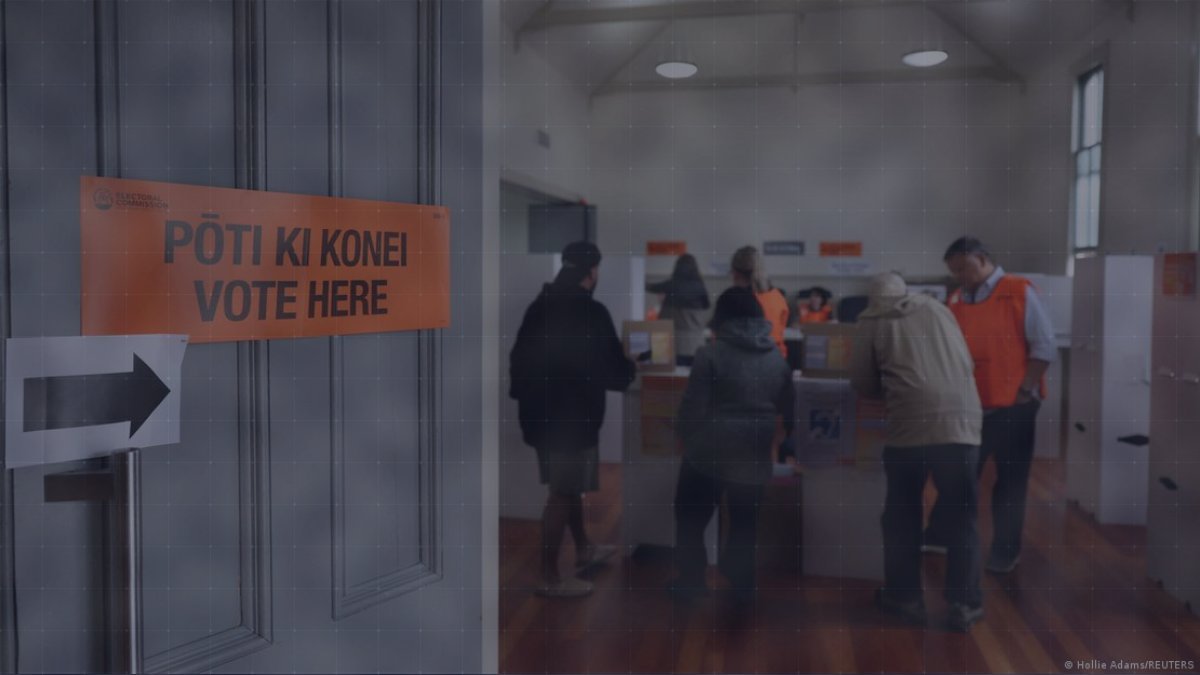
Polling stations across New Zealand shut at 7 p.m. local time on Saturday, ending a general election campaign in which neither of the two major parties established a clear advantage and the cost of living overshadowed almost everything else. Preliminary figures released soon after voting closed put the governing center-right National Party at close to 31% and the opposition Labour Party at just under 30%, a margin narrow enough to leave the shape of the next government unresolved.
- Key Point: Preliminary results placed National near 31% and Labour near 30%, with neither bloc on course for a single-party majority.
- Key Point: Roughly 1.7 million of the 3.8 million enrolled voters had already cast ballots by Thursday, reflecting widespread advance participation.
- Key Point: Final results, including ballots from New Zealanders overseas, are scheduled for release on November 27.
- Key Point: The centrist Opportunity Party polled above the 5% threshold in late surveys, positioning it as a possible coalition partner.
A campaign shaped by household budgets
Economic anxiety ran through the entire contest. Prices for everyday goods have stayed high, growth has been subdued and unemployment climbed to 5.7% in the third quarter, its highest reading in 11 years. Those conditions framed the choice for voters assessing three years of conservative-led government, and they also shaped the pitches of the smaller parties competing for influence.
Prime Minister Christopher Luxon, who leads National, is seeking a second term after his party won in 2023 on promises to pull the country out of its post-pandemic slump. He has pointed to trade agreements concluded during his time in office, but the recovery has been slow to reach households. His leadership has also been tested internally, with members of his own caucus reportedly challenging him in April and again in August; he survived both attempts.
Labour’s Chris Hipkins, who briefly held the premiership after Jacinda Ardern stepped down in early 2023 before losing that year’s election, is asking voters for a second chance. His platform centers on easing household costs and shoring up public healthcare, though polling has not shown Labour surging despite dissatisfaction with the incumbent coalition.
The prime minister, speaking to supporters and reporters before the blackout took effect, acknowledged the closeness of the contest.
It is going to be close. It will be tight, and that’s why you’ve got to get out and make sure you do vote.
Hipkins struck a more confident note at his own press conference, while declining to be drawn on post-election arrangements.
We’re banking on being the biggest party in Parliament. I’m feeling increasingly confident of that.
Smaller parties poised to decide the outcome
New Zealand’s mixed-member proportional system makes coalitions the norm rather than the exception, and the evenness of this year’s race means one or more minor parties will almost certainly sit in the next government. Under the system, voters mark two boxes: one for a local electorate candidate and one for a preferred party. Parliament normally seats 120 lawmakers, though an overhang can enlarge it. A bloc must command more than half the seats to govern.
Late polling put the centrist Opportunity Party at about 5.1%, just past the threshold that allows a party to enter Parliament without winning an electorate seat. That position could make it a kingmaker in negotiations. Support for parties on the ideological flanks has grown as confidence in National and Labour has eroded, a pattern seen in other Western democracies but arriving later in New Zealand.
The incumbent coalition, formed in 2023 with the populist New Zealand First and the libertarian ACT Party, has been described as the country’s most right-wing modern government. Its smaller partners pushed contentious measures on Indigenous Māori rights, drawing a march on Parliament of about 100,000 people. Winston Peters, who leads New Zealand First, voted in front of cameras in Auckland on the campaign’s last day.
Analysts see the outsized leverage of junior partners as a warning sign for whoever ends up governing. Ben Thomas, a former government press secretary now running a public affairs firm, said the smaller parties would demand more than in the past.
Whoever is in government after November 7 … will have to reckon with much more assertive minor parties that want much greater concessions and much more influence than they’ve had in the past.
He also pointed to a broader erosion of trust in the traditional duopoly.
I think there is a broader mistrust in the electorate of both of our traditional two major parties.
A silent final day, then a wait
Saturday itself unfolded with almost no political noise. New Zealand law imposes a blackout from midnight until polls close, making it an offense to say or publish anything that could sway a vote. Campaigning, advertising, opinion polls and exit polling are all barred, partisan billboards must come down, and even bumper stickers and social media profile pictures fall under the rules. Breaches can draw fines of NZ$20,000, roughly $11,000.
The restriction has its detractors, who argue it is redundant when advance voting has been open since October 26 and more than half of voters cast early ballots in 2023. Its defenders say it lets people vote privately and without interference. In place of political debate, a local tradition has taken hold of posting photographs of dogs outside polling places. Election officials use bright orange signage and uniforms, a color deliberately unaffiliated with any major party.
Turnout was substantial before election day. Electoral Commission figures showed about 1.67 million ballots cast through Thursday, more than a third of those enrolled. Enrollment rules changed under legislation enacted in December 2025, introducing a cutoff 13 days before the vote, meaning anyone not registered by October 25 this year could be turned away.
Officials aim to publish results from 95% of votes on election night, but the count will not be complete until overseas and postal ballots are folded in. Political commentators expect weeks could pass before a government takes shape, as parties wait for the final tally and then bargain over coalition terms.
The immediate question is whether the preliminary gap between National and Labour holds once special votes are counted, since those ballots have historically favored parties on the left. Beyond the arithmetic, the result will test whether voters’ frustration with stagnant wages and rising prices translates into a rejection of the incumbent coalition or simply a further fragmentation of the party system. Either way, the next prime minister will govern with less room to maneuver and more demands from partners who now know how much their support is worth.