

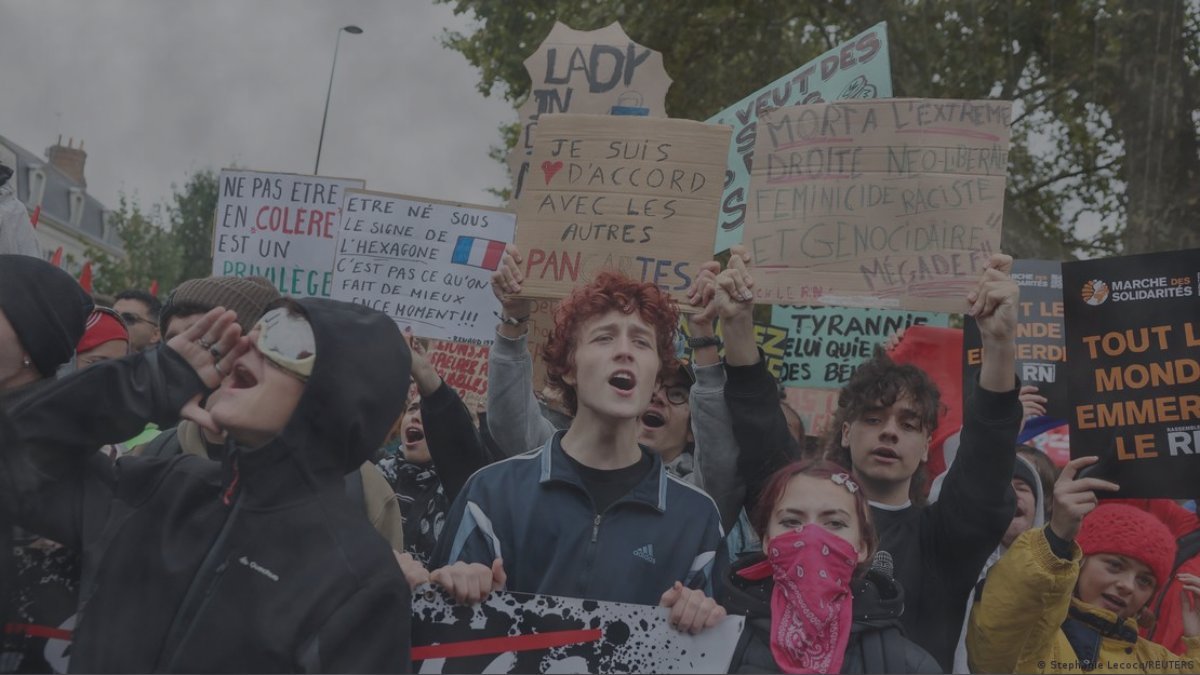
France deployed officers nationwide on Saturday, October 24, 2026, as demonstrations, a National Rally gathering in Orléans and heavy security in Paris converged. Interior Minister Laurent Nunez said 135 people had been detained and weapons taken. Museums and landmarks shut in the capital, the Yellow Vests called for October 31 actions, and Italy decided to send 500 more troops to Milan. Polling puts Marine Le Pen, whose far-right party held a two-day congress in Orléans, ahead in next year’s presidential race.
- Key Point: Nunez reported 135 arrests and seizures that included a katana, airsoft arms and other weapons; police were ordered to prevent renewed street violence, and he said no major incident had occurred.
- Key Point: In Orléans, south of Paris, marchers opposed the National Rally congress under the banner of “racism, fascism and imperialism”; signs backed Palestinians and Antifa, a placard referenced the Vichy regime and Nazi occupation, and CGT leader Sophie Binet joined.
- Key Point: The Louvre, Orsay and Picasso museums, the Grand Palais during a Paul Cezanne show, Art Basel Paris after its Friday opening, and the Tuileries and Arc de Triomphe were shut; Champs-Élysée access was restricted.
- Key Point: Yellow Vests scheduled rallies and sit-ins for October 31 against Macron’s “authoritarian drift”; Meloni added 500 soldiers in Milan, while other Italian cities and Albania, Spain and Portugal faced protest plans.
Security, arrests and readiness
Nunez announced the nationwide deployment and the arrest total, saying police were told to prevent a return of street violence. Among confiscated items were fireworks, slingshots, steel balls, lead pellets, metal balls, airsoft weapons, a katana and improvised weapons. He added:
there has been no major incident.
Earlier that morning, Nunez said in a social-media post that he had met members of the Paris intervention unit, which supplies part of the capital’s mobilized contingent. He said:
Our forces are mobilized, our setup is in place. We are ready.
Orléans counter-rally and a locked-down Paris
In Orléans, south of Paris, demonstrators took to the streets against the two-day congress held by Marine Le Pen’s far-right group. Polls make Le Pen the leading candidate in next year’s presidential election. Organizers framed the protest as opposition to “racism, fascism and imperialism.” Participants carried signs supporting Palestinians and the leftist Antifa movement. French security personnel were also present in large numbers in case the demonstration lost control. Some banners invoked the Vichy regime and Nazi occupation, including one that read:
France will never be owned by the nostalgics of Vichy and the Reich
Sophie Binet, who heads the CGT trade union confederation, took part; a photograph showed her in a red scarf.
In Paris, troops guarded sensitive sites as part of Operation Sentinelle. The Louvre, Orsay Museum, Picasso Museum and Grand Palais were closed; the Grand Palais was hosting a major Paul Cezanne exhibition. Art Basel Paris, a contemporary art fair that opened to the public Friday, shut the following day and scrapped its weekend program. The Tuileries Gardens, already closed Friday because of storms, stayed shut. Visitors could not enter the Arc de Triomphe, and access was restricted to the Champs-Élysée leading toward it and to other key locations. The moves came after rioting, sometimes violent, on the margins of mass demonstrations on October 17.
Yellow Vests, Milan and European spillover
The Yellow Vests, prominent in recent cost-of-living protests, announced October 31 rallies and sit-ins outside parliament and city halls nationwide against President Emmanuel Macron’s “authoritarian drift.” Largely rural-based organizers in Paris said members refused a police order to shift a union-organized march to Paris’s edge, though unions agreed. A coordinator at Bastille square, the planned start, said:
we will protest for the freedom to protest, and for all our freedoms.
Central to fuel-price protests in 2018-2020, the movement faded before returning during the current wave.
Italian Prime Minister Giorgia Meloni sent 500 extra soldiers to Milan, joining hundreds already there, to support about 5,000 police and law-enforcement staff and prevent a repeat of last week’s looting and violence. Authorities use drone surveillance, railway checks and online scrutiny of possible calls to violence. Rome locked down luxury shopping streets and tightened controls near Circus Maximus and Piazza del Popolo before planned rallies. At least seven other Italian cities have demonstrations; Albania, Spain and Portugal also face Saturday protests, with Albania facing education shortcomings and Spain and Portugal housing-affordability shortages.
Next tests: violence-free passage of the National Rally congress and the October 31 Yellow Vest deadline, and whether Paris closures and Milan reinforcements form a European pattern.