

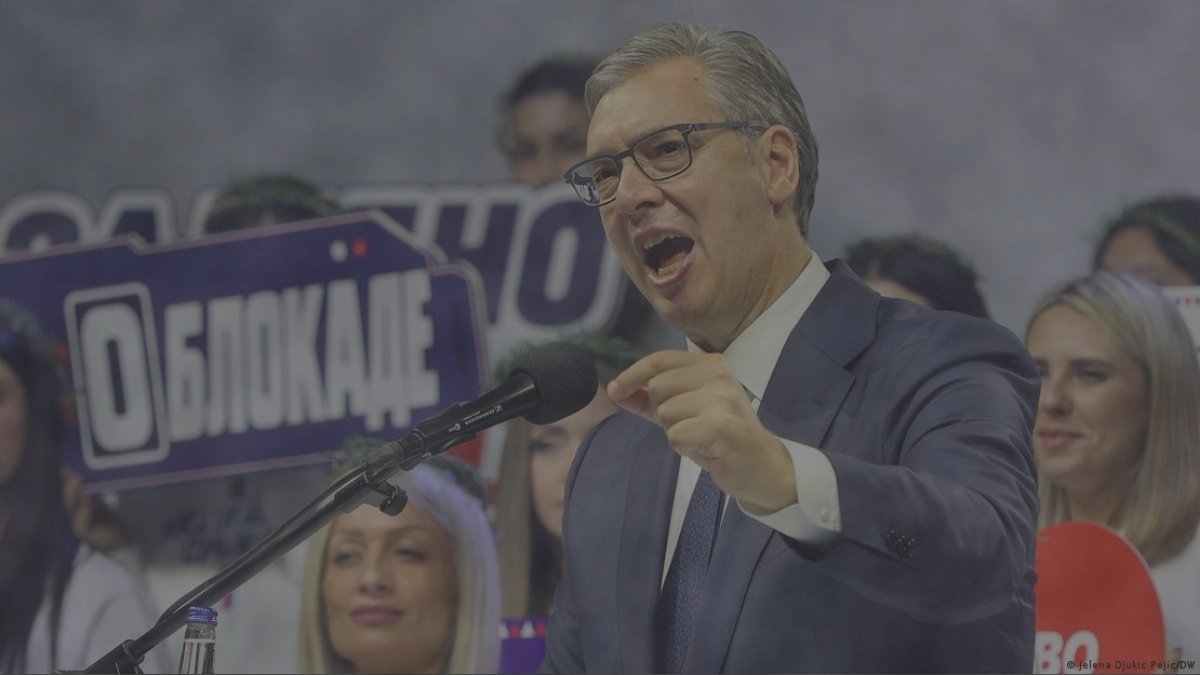
Serbia votes Sunday in a parliamentary election that tests whether Aleksandar Vucic’s long dominance can survive the Students’ List, a youth-backed force born from nearly two years of street protest. Polls point to a tight race between Vucic’s right-wing populist Serbian Progressive Party (SNS) and the new movement, which seeks to end 14 years of SNS rule. Vucic called the snap vote last month, stepped down as president and is running for prime minister after more than a decade dominating Serbian politics. The ballot follows protests triggered by a deadly 2024 canopy collapse at a Novi Sad railway station; they became the country’s largest mobilization since Slobodan Milosevic fell in 2000.
- Too close: An Ipsos poll Thursday put SNS at 47% and the Students’ List at 40%; other surveys have students ahead, leaving the result open.
- Trigger: Sixteen died when a canopy at Novi Sad’s refurbished station fell on November 1, 2024, along a Belgrade–Budapest line Vucic promoted as a signature project.
- New office: Barred from a third presidential term, Vucic resigned and now runs for prime minister; his party has governed 14 years.
- Voting hours: Polls run 7 a.m. to 8 p.m. (1900 GMT), with early signs about two hours later in a country of roughly 6 million.
From a fatal collapse to an electoral movement
Concrete gave way at Novi Sad’s recently renovated station on November 1, 2024, killing 16. The station sat on a route meant to connect Belgrade and Budapest — a project Vucic had presented as proof of his modernization drive, which made the deaths politically hard to contain. Calls for accountability widened into anger over corruption and what protesters call creeping authoritarianism, becoming the largest wave of mobilization since Milosevic’s 2000 ouster.
Miloje Savic, a Serbian who travelled from Brussels to Belgrade to vote and observe, said the movement entered electoral politics after what he called institutional silence over the disaster. He contends Vucic pardoned 49 people on his last day as president, some of whom he suspects were under investigation over the collapse.
Vuk Stojic, a law student at Novi Sad University who helped choose candidates, said the list offers something deliberately unfamiliar.
“This is not only a student movement. It’s a movement of all the free-thinking people in Serbia. And that’s what gave us strength.”
Vucic campaigns on delivery and denial
Vucic has governed Serbia for well over a decade, first as prime minister, then as president. The constitution blocks a third presidential term, so he stepped down last month and now leads the SNS into the prime ministerial race.
His offer is material: bigger pensions, public-sector raises, more health funding and subsidies for young couples. Many voters credit him with lifting the economy from obscurity and building highways, railways, schools and hospitals. Abroad, he balances ties with China, a major investor, and Russia, the main gas supplier, while keeping EU membership in view.
He denies corruption, repression and spying on opponents, and says the students are funded by foreign agents in Croatia and Montenegro; the movement rejects that. Monitors have long noted his advantages, from his party’s dominance of television to its use of state resources. A Council of Europe delegation visiting this month flagged hostile, aggressive rhetoric against opponents, and European Commission President Ursula von der Leyen condemned the large Belgrade funeral in September for convicted war criminal Ratko Mladic.
At a Novi Sad rally, Vucic was defiant.
“We’re going out there to win. We’re going out there to defeat them, and we’re going to deliver our biggest landslide victory yet.”
Reflecting on the campaign, he sounded another note.
“This has been one of the most difficult but the most emotional campaigns. We stood against those who wanted to destroy Serbia.”
A 250-name slate and an 11-point program
The students did not run themselves. Drawing on protest networks, they recruited 250 candidates with no political record — professors, economists, actors, farmers, engineers and athletes — under cardiologist Ilija Srdanovic.
Mihail Dudas, an Olympic decathlete on the list, described the objective plainly.
“I want people to be free — to be free to say whatever they want, to be free to talk about the political situation, to talk about the solutions.”
The programme has 11 points in four areas: anti-corruption and institutional accountability; social and economic reform; media freedom and constitutional rule; and statehood and non-alignment. Abroad, it wants Serbia to keep refusing to sanction Russia while respecting Ukraine’s territorial integrity, and it rejects Kosovo’s independence. On the EU, it promises IBAR status — the benchmark for provisionally closing accession chapters — through progress on the judiciary and fundamental rights and on justice, freedom and security.
Mirjana Nikolic, rector of the University of Arts in Belgrade and a candidate, argues these positions follow from Serbia’s own constitution, which defines the country as a republic founded on the rule of law, social justice and European principles and values.
About 150,000 people attended the Students’ List closing rally at Slavija Square in Belgrade. Analysts see consequences beyond the Balkans.
“The Serbian election is shaping up to be a watershed moment for the country as the Student List mounts the biggest challenge against Vucic yet.”
That assessment came from Mario Bikarski, a senior Europe analyst at risk consultancy Verisk Maplecroft. A student victory would echo Peter Magyar’s April defeat of Vucic ally Viktor Orban in Hungary and offer a template for youth movements recently protesting elsewhere in Europe.
Voting ends at 8 p.m. (1900 GMT), with first signals around two hours later. An SNS win would return Vucic to the prime minister’s office with his dominance intact; a Students’ List win would end 14 years of Progressive Party government. Either way, Serbian voters face a result that is not predetermined — something they have lacked for more than a decade.