

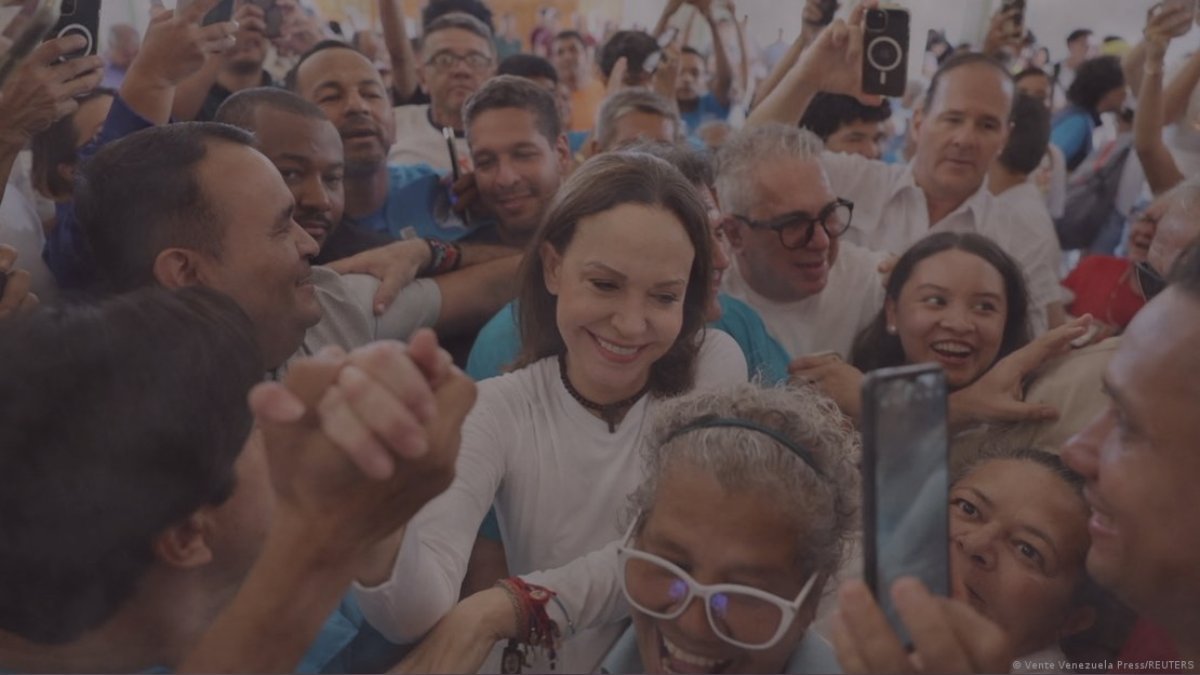
María Corina Machado, the Venezuelan opposition leader, returned home on Sunday after nearly a year in exile and was greeted in Caracas by thousands of cheering supporters. People stood along highways, at toll plazas and on city streets, waving Venezuelan flags and chanting “freedom” as a convoy of cars and motorcycles moved her toward the capital. In her familiar white T-shirt and blue jeans, Machado leaned out of a sunroof and shouted to the crowds as the procession entered Caracas:
“this country is giving lessons to everyone”
.
- Key Point: Machado’s return unfolded on Sunday, with her public appearances beginning outside Caracas and ending in the capital amid crowds that had waited for her.
- Key Point: In Guacara, AFP reported seeing her perform the national anthem for a crowd-packed plaza of supporters who waved flags and cheered.
- Key Point: She left Venezuela last December for the Nobel Peace Prize ceremony, having taken refuge in the Argentine embassy in Caracas because she feared arrest by former President Nicolas Maduro’s government.
- Key Point: Although Washington helped her escape, it later backed interim President Delcy Rodriguez rather than Machado; Machado says U.S. worries and Rodriguez’s interference contributed to her prolonged absence.
A homecoming staged in public
The day’s images traced a route from the interior to the capital. In Guacara, AFP reported, Machado sang the national anthem while surrounded by a plaza full of backers; they waved flags and cheered her return. Later, her motorcade of cars and motorcycles made its way into Caracas, where people gathered along roads and at toll plazas. The journey became a public procession rather than a quiet homecoming, with supporters chanting “freedom” and treating her presence as a political statement. Machado’s white T-shirt and blue jeans matched the visual signature she has used in past appearances, and her decision to lean out of the sunroof gave the crowds a direct, unscripted moment. The scene underlined a simple fact: even after months away, Machado retains a capacity to draw people into the streets. It was a moving display, not a fixed-stage rally, and it allowed supporters to claim roads and plazas as their own.
Why Machado was outside Venezuela
Machado’s absence was not voluntary. She departed Venezuela last December to collect the Nobel Peace Prize awarded for her work promoting democracy in an autocratic country. Before that exit, the threat of detention by the government of former President Nicolas Maduro drove her into the Argentine embassy in Caracas; she was then smuggled abroad with help from the United States. Once outside, she initially could not come back because she feared authorities would detain her. Her eventual return became entangled with a larger political shift: after a U.S.-led operation removed and arrested Maduro, Machado gave Trump her Nobel medal. Yet her prolonged inability to go home was also tied to the Trump administration’s choices. Rather than supporting Machado, Washington threw its weight behind interim President Delcy Rodriguez. Machado’s exit was forced by danger, but her stay abroad was extended by diplomacy and by the politics of the transition. Instead, Washington settled on Rodriguez, the interim president. That choice created a gap between Machado’s moral authority and the practical authority recognized by the United States. Her account of travel restrictions and canceled flights fits into that gap: it describes a return blocked not by a single order but by a combination of security fears, administrative obstacles and political resistance.
A return shaped by competing loyalties
Machado has described the obstacles to her return in terms that mix official restrictions with political calculation. She has said she confronted travel restrictions and canceled flights. In her account, part of the problem came from Trump’s concern that her arrival could raise tensions during a transition, and part came from interference by Rodriguez. Those claims sit alongside the broader reality that the interim president enjoys Washington’s support. The result is an awkward picture: the United States helped Machado escape danger and later received her Nobel honor, but it also chose Rodriguez as its partner in governing. Machado’s homecoming therefore does not simply close a year of exile; it exposes the competing loyalties inside the arrangement that followed Maduro’s removal. It reflects a transition in which different kinds of legitimacy are in play. Machado can claim the loyalty of crowds and the recognition of the Nobel award. Rodriguez can claim the title of interim president and the backing of Washington. Trump, for his part, received Machado’s Nobel medal after Maduro was removed and arrested, a gesture that made her admiration for him visible even as his administration chose another leader. Machado’s supporters may see the medal as a symbol of shared purpose; her critics may see it as evidence that her influence depends on powerful patrons. Either way, the episode shows that the post-Maduro order was not built around Machado’s leadership, even though she remains one of its most recognizable opposition figures.
The political meaning of Sunday is less certain than the crowds. Machado returns to a country where interim President Delcy Rodriguez governs with backing from the same U.S. administration that Machado says contributed to her long stay abroad. Street enthusiasm is not a change in the governing arrangement, and Washington’s preference for Rodriguez leaves Machado outside the center of power. Her return may open space for pressure or a new opposition push, but it may leave the balance intact. What follows depends on whether Machado can turn visibility into leverage, and whether Rodriguez and Washington treat her homecoming as a challenge or a signal that the transition must change course.
Wesley Rahn edited the report.