

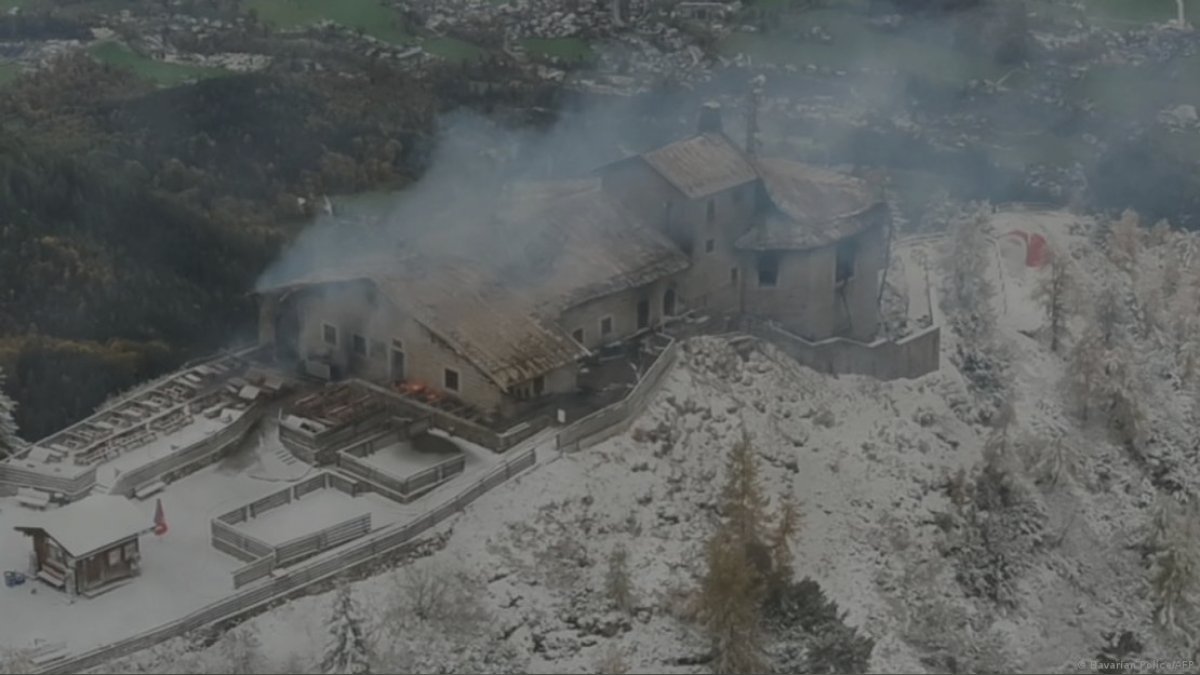
Embers glowing inside the gutted Kehlsteinhaus, the Alpine guesthouse above Berchtesgaden better known as the Eagle’s Nest, burst back into flames overnight into Sunday, two days after a blaze left one of the most notorious surviving structures of the Nazi era almost completely destroyed. Bavarian police said the flare-up sent firefighters back up the Obersalzberg mountain. A 33-year-old German man detained at the scene on Friday remains the only suspect, and prosecutors say an initial psychiatric assessment found indications of mental illness.
- Fire reignites: Police reported flames again at “room height” inside the ruined shell during the night into Sunday, a recurrence they described as typical when embers stay hot in a badly damaged building.
- Arson investigation: The suspect was stopped on a motorcycle heading down the mountain road as fire crews drove up; investigators are examining a possible political motive alongside evidence of mental illness.
- Severe damage: About 200 emergency personnel were deployed on Friday night, and the building, a restaurant and tourist attraction since 1952, has been largely destroyed, with losses counted in the millions of euros. Nobody was hurt.
- No ruin: Bavaria’s interior minister says the state, which owns the property, will not leave a wreck on the summit, though no decision has been taken on what should replace it.
An alarm, a snowstorm and a fire that would not stay out
The first signal came from a smoke detector shortly after 9 p.m. local time on Friday. Crews climbing the narrow access road, which passes through tunnels cut into the rock, could see flames above the building before they reached it and found the structure ablaze, according to police. Around 200 emergency personnel were committed to the operation. Rain that turned into the year’s first snow, combined with strong wind, complicated an already difficult task, and the retreat’s remote position at 1,834 metres (6,017 feet) above sea level slowed the response, a police spokesperson said. Firefighters pulled back overnight after several hours and could not enter the building on Saturday because of the risk of falling material. Police said the interior flared up again during the night into Sunday, with flames once more reaching “room height” — a pattern, an officer said, that is common when embers keep burning inside a badly damaged structure.
A suspect stopped on the road down
According to investigators, the man was riding a motorcycle down the mountain as emergency vehicles were on their way up, and was arrested near the scene. He is a German citizen with links to the Berchtesgaden area who does not currently live there, and he was later taken to a psychiatric facility. Public prosecutor Rainer Vietze said a psychiatric report had concluded that the 33-year-old showed signs of possible mental illness, so diminished responsibility might be assumed, but he stressed that inquiries were at an early stage. A political motive is also being examined in view of the building’s history. Police official Gerhart Holzinger told reporters there was nothing to suggest that anyone else was involved.
A difficult legacy, and the question of what comes next
Completed in 1938 from stone and granite and reached by an elevator bored into the rock, the Kehlsteinhaus was conceived as a monument to Hitler’s rule and a setting for receiving foreign diplomats, though the Nazi dictator himself rarely stayed there. He preferred the nearby Berghof, whose ruins were blown up in 1952. The Eagle’s Nest came through the Second World War undamaged and has operated as a mountain inn and restaurant since 1952, with an exhibition on its history; its own website calls it “a cautionary reminder of the abysses of the inhumane Nazi dictatorship”. The Obersalzberg Documentation Center further down the mountain, home to the region’s main historical exhibition, was unaffected.
Bavaria’s state government owns the building, and interior minister Joachim Herrmann travelled to the site to make clear that the state intends to rebuild rather than leave rubble on the summit.
“We’re not going to leave a ruin there. I think we will be able to find a sensible solution.”
He added: “It is important that we continue to do the work of remembrance.” What the site will eventually look like will be settled with local officials, historians and preservationists, and no timetable has been given.
How Germany handles buildings associated with the Nazi period has been contested for years. Some argue that such sites must be preserved so the history can be told; others warn that they can become gathering points for neo-Nazis and far-right extremists. In June, Berlin authorities announced they would demolish one of Hitler’s bunkers to build flats and offices, a plan criticised by those who wanted a museum and memorial instead. In July, after years of argument, Austrian authorities completed the conversion of the house in Braunau am Inn where Hitler was born into a police station.
The immediate priority is the criminal case: prosecutors must decide whether the fire was the act of a disturbed individual, a politically motivated attack, or both, and the psychiatric assessment will shape how any trial proceeds. Beyond that, the destroyed inn leaves Bavaria with a decision it has postponed for decades — whether to restore a restaurant on the summit, turn the shell into a memorial, or settle somewhere in between. Herrmann’s pledge rules out only one option: walking away.